Forecast Engine 2.0: High-Fidelity Predictive Modeling for Complex Data Streams

Forecast Engine 2.0 (FE 2.0) represents a new class of predictive analytics frameworks designed to handle the rising complexity, scale, and dynamism of modern data streams. As organizations contend with real-time, high-dimensional, and rapidly evolving data sources, traditional forecasting techniques—largely based on stationary assumptions and batch-learning paradigms—are no longer sufficient. FE 2.0 proposes a high-fidelity modeling approach that integrates adaptive learning, probabilistic forecasting, and scalable architectures to produce reliable predictions in environments characterized by uncertainty and continuous change. This paper outlines the conceptual design, operational mechanisms, challenges, applications, and future research directions for Forecast Engine 2.0.
1. Introduction
Modern digital ecosystems generate continuous streams of heterogeneous data, including sensor data, transactional records, user interactions, environmental measurements, and operational telemetry. These data streams often exhibit complex temporal dynamics, irregular fluctuations, multi-scale patterns, and non-stationary behaviors. As a result, forecasting systems must not only produce accurate short-term predictions but also adapt quickly to structural shifts and quantify uncertainties.
Forecast Engine 2.0 is envisioned as a next-generation forecasting platform that delivers high-fidelity predictive modeling across such complex data environments. High fidelity implies the ability to capture fine-grained patterns, maintain consistency across correlated variables, and reflect uncertainty in forecast outputs. FE 2.0 emphasizes adaptivity, robustness, and scalability—three pillars essential for real-time predictive intelligence.

2. Architectural Overview
Forecast Engine 2.0 is structured as a multi-layered architecture that integrates data ingestion, adaptive modeling, uncertainty quantification, and scenario generation. Its core components include:
2.1 Data Ingestion and Preprocessing Layer
This layer handles continuous input from diverse data streams. Key functions include:
Real-time cleaning and anomaly filtering
Handling missing or delayed observations
Feature engineering (trend decomposition, lag extraction, seasonality encoding)
Dynamic normalization that adjusts as distributions shift
Because data streams may change characteristics abruptly, FE 2.0 includes automated drift detectors to flag unexpected deviations in data behavior.
2.2 Adaptive Modeling Core
The core functionality of FE 2.0 lies in its hybrid modeling structure:
Online learning models, which update incrementally as new data arrives
Deep sequence networks, such as recurrent, convolutional, or attention-based models, adapted for streaming contexts
Hybrid physical–statistical models, incorporating mechanistic knowledge where available
Multivariate dependency modules, ensuring consistent predictions across interacting variables
The engine continuously adjusts its parameters or structure, allowing it to learn new patterns without full retraining.
2.3 Probabilistic Forecasting Module
Rather than producing fixed point predictions, FE 2.0 generates probabilistic outputs, capturing the full distribution of possible outcomes. This allows downstream systems to evaluate risk and make more robust decisions.
The probabilistic module employs:
Ensembles of lightweight models
Variance estimators that evolve with the data
Uncertainty calibration mechanisms to prevent over- or underconfidence
2.4 Scenario Generation Engine
To support planning and risk analysis, FE 2.0 includes a scenario generator that produces:
Alternative future trajectories under different assumptions
Coherent multivariate forecast paths
Synthetic simulations capturing extreme or rare events
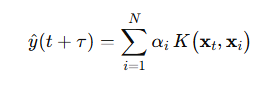
EQ.1. Nonlinear Forecasting Kernel (High-Fidelity Regression Core):
3. Key Challenges
Designing Forecast Engine 2.0 involves solving several technical and operational challenges:
3.1 Concept Drift
Data streams may change their statistical properties suddenly. FE 2.0 must detect and adapt to drift without discarding useful historical patterns. This requires balancing responsiveness with stability.
3.2 Scalability
In high-volume environments—such as IoT networks, financial markets, and industrial systems—forecasts may be needed for thousands of parallel time series. The engine must scale horizontally and perform updates efficiently in real time.
3.3 Computational Efficiency
High-fidelity forecasting often requires complex models. FE 2.0 must provide near-instant inference while keeping computational overhead manageable.
3.4 Multivariate Consistency
When forecasting multiple interrelated variables, maintaining joint coherence is critical. Simple independent models cannot ensure realistic co-movements, leading to physically or logically inconsistent predictions.
3.5 Robust Uncertainty Quantification
Uncertainty estimates must remain reliable even as environments change. Achieving this in adaptive, online settings is inherently difficult.
4. Applications
Forecast Engine 2.0 can transform predictive workflows in many data-intensive sectors:
4.1 Energy and Utilities
Predicting load curves, renewable generation, grid conditions, and equipment degradation—all in real time—requires adaptive models with strong uncertainty handling.
4.2 Finance and Economics
Market microstructure data, algorithmic trading signals, and macroeconomic indicators benefit from streaming forecasts that adapt to regime shifts.
4.3 Smart Cities and IoT
Traffic flows, environmental sensors, transportation networks, and resource usage patterns form dense webs of interconnected data streams ideal for FE 2.0.
4.4 Industrial Operations
Predictive maintenance, supply chain optimization, and manufacturing quality assurance require continuous forecasting to prevent failures and optimize throughput.
4.5 Climate and Weather
While full-scale meteorological models remain complex, high-frequency data streams from local sensors can be enriched by FE 2.0 to produce localized micro-forecasts.
EQ.2. High-Fidelity Multi-Step Forecast Objective:

5. Future Directions
Several promising research directions can further advance FE 2.0:
Federated and edge-based forecasting, reducing the need for centralized data aggregation
Meta-learning, enabling the engine to learn how to learn from evolving data
Causal forecasting frameworks, moving beyond correlation toward explanatory structure
Human-in-the-loop workflows, allowing analysts to guide or correct models interactively
Adaptive model compression, ensuring high fidelity even in resource-restricted environments

6. Conclusion
Forecast Engine 2.0 aims to redefine predictive modeling for the modern era of continuous, complex, and high-dimensional data streams. By integrating adaptive learning, probabilistic forecasting, and scalable architecture, it provides high-fidelity predictions capable of supporting real-time decision-making across diverse domains. Although significant challenges remain—particularly in drift adaptation, uncertainty calibration, and multivariate coherence—FE 2.0 provides a powerful blueprint for the next generation of forecasting technology.
Comments
Join the discussionNo comments yet. Be the first to comment.


